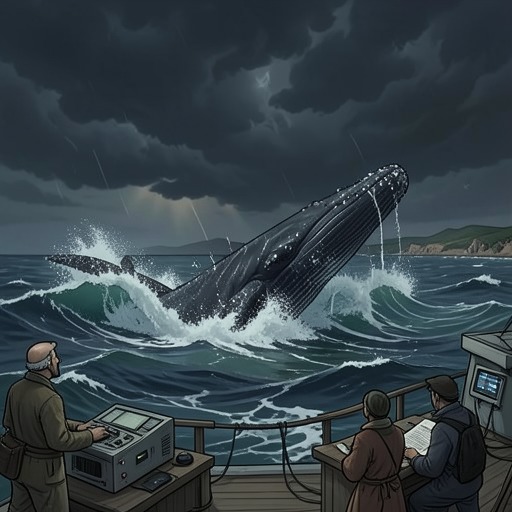
1658 Thames whale stranding and capture
The WhaleThe 1658 Thames whale stranding and capture joined natural history, public spectacle, and political omen in a single event. A right whale appeared in the river during a storm, where people gathered to see it before it was killed and brought ashore. The episode was remembered not only for the animal’s unusual presence in the river but also for the meaning people attached to its arrival and for the bones that remained as a public landmark.
Arrival and Omen
The whale appeared in the Thames in 1658, during a storm. To some shore dwellers, a beached whale could be understood as a gift; in this case, observers treated the animal’s arrival as an ill omen. Because Oliver Cromwell died the next day, the stranding was associated with the Lord Protector’s impending death. The coincidence gave the event a political meaning that outlasted the whale’s brief presence in the river.
John Evelyn, whose estate overlooked the Thames, recorded that the animal drew an immense crowd. Visitors came by boat, horse, and coach, on foot, from the capital and from farther afield. The whale thus became a shared spectacle: its passage into the river prompted an exceptional gathering, while its interpretation as an omen turned a rare animal encounter into a story about human affairs.
Capture and Description
The animal was a right whale, a species more suited to plankton-rich waters than to the Thames and its floating detritus. It first appeared at low water; Evelyn noted that its arrival at high water might have endangered the boats. Cornered in unfamiliar surroundings, it resisted before being killed with harpoons and brought ashore. The account records both the practical danger perceived by river users and the force used to end the encounter, without suggesting any rescue effort.
Evelyn also measured and described the whale. He recorded a length of 58 feet and a height of 16 feet, along with small eyes, a large tail, two small fins, and a pointed snout. It had no teeth: instead, it fed by drawing in slime through a broad mouth lined with what was then called whalebone. Evelyn was struck by the question of how an animal of such size could live on so little apparent food. His observations make the record more than an omen narrative: they preserve an early attempt to examine the stranded animal as a creature with a distinct body and way of feeding.
Bones and Afterlife
The whale’s remains acquired a second life as a monument. In 1721, Daniel Defoe recorded that a large whale rib had been set up beside the road to Colchester, at a place known as Whalebone. The bone was identified with the whale taken from the Thames in 1658 and with the year of Cromwell’s death. Whalebone Lane still exists in Dagenham, and the bones are preserved in a local museum. The sequence—from living animal, to public spectacle, to measured specimen, to landmark and museum remnant—shows how the event was repeatedly recast for human understanding and use.
From Portent to Resource
The 1658 episode sits within a longer history in which people interpreted whales according to their own needs and beliefs. In later accounts, a whale might be treated as an omen, a scientific object, or a source of oil and other materials. The discovery of oil at Titusville, Pennsylvania, in 1859 marked a turning point for the sperm-whale fishery, while the grenade harpoon patented by Sven Foyn in 1868 extended commercial hunting to large rorquals. During the two world wars, whales were also killed for products used in wartime manufacture; the book records 50,000 deaths across the conflicts and describes the extinction of the South Atlantic humpback population by 1918.
That expanding history gives the Thames whale’s capture a sobering context without changing what is known about the 1658 event itself. The animal was first read as a portent, then described and measured, and finally remembered through its bones. Later discussions of endangered whale populations and the extinction of the Yangtze River dolphin underscore the costs of treating animal life chiefly through human interpretation or utility. The surviving record preserves a specific encounter, while also revealing how readily attention to a whale could turn into possession of it.